
Understanding the shifting dynamics of power, place, and global governance requires more than textbook summaries.
Globalization and Its Discontents by Joseph E. Stiglitz is a powerful critique of the institutions and mechanisms that have shaped the modern global economic order. It is especially relevant to IB Geography Unit 4: Global Interactions, particularly the Superpowers topic and subthemes like global institutions, trade, FDI, and the geopolitics of development.
TLDR: Joseph Stiglitz dismantles the illusion that global economic institutions are neutral arbiters of development. Behind the language of “aid” and “reform” lies a system in which powerful nations—primarily in the Global North—write the rules, enforce them, and benefit from them. Institutions like the IMF, World Bank, and WTO operate less as helpers and more as instruments of geopolitical strategy: they impose structural reforms that discipline rather than develop.
These reforms also deepen dependency, and extract compliance through debt. Poor countries are told to liberalize, privatize, and open up—while rich nations protect their own markets and subsidize their industries. Stiglitz exposes how free trade is rarely fair trade, and how multinational corporations exploit global asymmetries to shift profits, shape policy, and pressure states into deregulation. In a supposedly shrinking world, he reminds us that while distance may have collapsed, power has not: globalization continues to serve those who already control its terms.
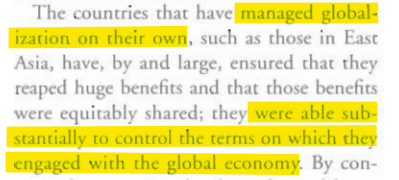
The former Chief Economist of the World Bank and Nobel Prize winner doesn’t reject globalization outright, in fact, he accepts the benefits of globalization, if and only IF, governments themselves play active roles in managing the terms. Without this, they risk subjugation under rules written by those in power. Pointing to South Korea as a success story, he notes that its steel industry was “among the most efficient in the world,” outperforming even private-sector rivals in the United States.
Superpowers Write the Rules — And Enforce Them
Stiglitz is blunt: institutions like the IMF, World Bank, OECD, and even the G20 don’t serve the world equally. They reflect the interests of the most powerful—mainly the U.S. and its allies.
“What is needed is not just a change in the rules of the game, but a change in the way the game is played—who writes the rules and who enforces them.”
In IB terms: these aren’t just development institutions. They are tools of global power projection—invisible levers that shape the Global South’s economic choices.
Debt as Discipline: SAPs and the Politics of ‘Aid’
When poorer countries (HIPCs) borrow from the IMF or World Bank, the loans often come with strings attached (conditionalities). These usually include policies like cutting government spending (austerity), privatizing state enterprises, opening markets to foreign competition, reducing subsidies, and devaluing currency. SAPs (Structural Adjustment Programmes) imposed austerity, forced privatization, and exposed local industries to foreign competition—often deepening poverty and limiting autonomy.
“The IMF was not participating in a conspiracy, but it was reflecting the interests and ideology of the Western financial community.”
These programs didn’t just “fail.” They served someone else’s model of success. A clear case of debt being used to discipline, not develop.
Free Trade, But Not Fair
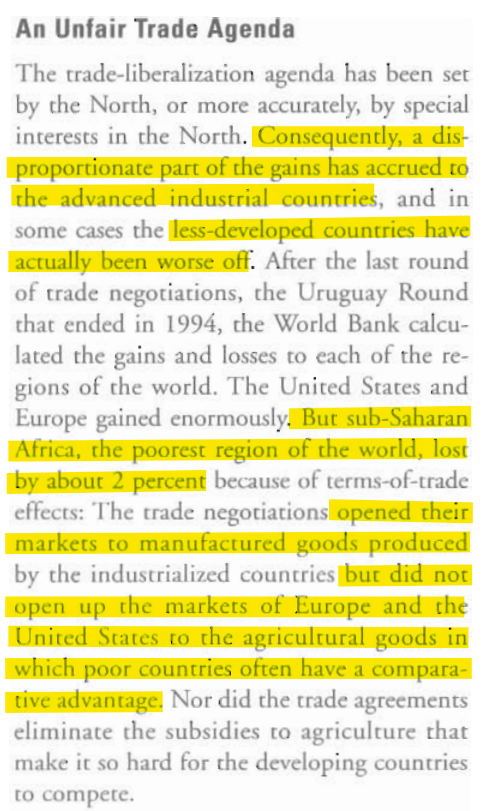
Globalization promised open markets. But Stiglitz shows how trade liberalization worked one way to keep the poor in poverty: the Global South opened up; the North didn’t.
“The developing countries were told to open up their markets, but the developed countries did not open theirs.”
This is textbook unequal exchange. A system where FDI, MNCs, and trade “openness” often mask deeper imbalances in who controls flows of capital, labour, and value.
MNCs Don’t Just Trade — They Rule
Stiglitz argues that MNCs are not just economic actors but political players. They exploit global rules, shift profits, shape policy, and escape accountability. Stiglitz warns that while globalization has potential, its management—especially by powerful institutions and through FDI and trade rules—has enabled MNCs to leverage power, not just trade.
- MNCs can choose among countries the legal, tax, environmental regimes that favor them. This gives them leverage over states, especially weaker ones that compete for FDI. They may push for deregulation or tax breaks in exchange
- Powerful states (home countries of many MNCs) often influence institutions (WTO, trade treaties) to protect or advance corporate interests. This shapes policy not always in the interest of local populations
A Shrinking World — Still Divided
Globalization shrinks time–space distances. But it hasn’t closed the gap in wealth, power, or influence. The problem isn’t that globalization exists—it’s who controls it, who benefits, and who decides the terms.
“Globalization today is not working for many of the world’s poor. It is not working for much of the environment. It is not working for the stability of the global economy.”
Below is a curated selection of thought-provoking works that directly enrich your understanding of Unit 4 themes—especially around superpowers, global institutions, trade, and the political economy of globalization.
Unit 4—Power, Places & Networks
The World Is Flat: A Brief History of the Twenty‑First Century – Thomas L. Friedman
Emerging Powers and the World Trading System – Gregory C. Shaffer
The City: London and the Global Power of Finance – Tony Norfield