
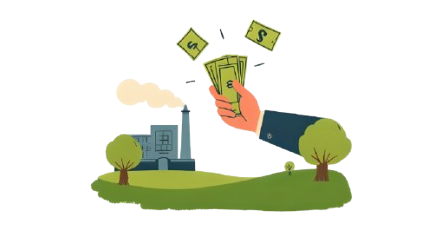
Carbon trading and carbon offsetting are two powerful free market tools designed to curb global greenhouse gas (GHG) emissions. Both aim to reduce overall carbon footprints but work differently.
- Carbon trading ( or “cap-and-trade”) sets a limit on total emissions and allows companies to buy and sell permits to emit. First, the government creates a market where companies buy and sell the right to emit carbon, encouraging these companies to cut emissions to save money or profit
- Carbon offsetting lets companies or individuals compensate for their emissions by funding projects that remove or reduce carbon elsewhere, like planting trees or investing in renewable energy
Carbon Trading
- Government-imposed limits: Governments set strict GHG emission limits/quota for companies and issues permits based on the limits
- Excess permits can be sold: If a company emits less than its allotted amount, it can sell its unused permits to other companies.
- Financial incentive: This system encourages companies to reduce emissions, adopt cleaner technologies, and improve efficiency in order to sell surplus permits for profit
By setting a cap on emissions and making unused allowances tradable, this system directly incentivizes reductions. Companies that cut emissions can profit by selling permits to higher emitters, driving down overall emissions over time. The government can also manage emission volumes by setting tighter caps down the road.
For example, the European Union Emissions Trading System (EU ETS), the world’s first and largest carbon market has been successful in reducing emissions by encouraging industries to cut their carbon output and sell unused credits to those who need them.
Carbon Offsetting—Compensation
Carbon offsetting takes a different approach. Instead of limiting emissions, it focuses on compensating for them through projects that reduce or remove GHGs. Here’s how:
- Support for GHG-reducing projects: Individuals or companies can pay for activities like tree planting, renewable energy projects, or forest conservation, which help absorb or reduce carbon from the atmosphere
- Neutralizing emissions: Carbon offset schemes essentially “neutralize” the emissions produced elsewhere. For example, a company can fund a reforestation project to balance out the CO₂ they release through their operations
Projects like forest conservation or renewable energy installations counteract the carbon produced by individuals or companies, helping neutralize their impact on the planet.
Evaluation
Carbon offsetting lets people pay to balance emissions by funding green projects. But it can feel distant and impersonal, sometimes just easing guilt instead of driving real change. This may reduce motivation to cut emissions directly. Some projects also don’t deliver results quickly. In IB exams, remember: offsets help, but real emission cuts must come first.
Both carbon trading and carbon offsetting help push us toward a low-carbon economy, where businesses and consumers feel compelled to take action. Whether through incentivizing emissions reductions or funding climate-positive projects, these strategies contribute to tackling the global climate crisis.
P.S The exam content in these posts is stripped down to the bare minimum for quick revision. Full A03 evaluation with detailed case studies available here.
TNC Strategies: Fast, Focused, but Limited
- Financially-driven change: Carbon trading uses market forces to drive emission reductions.
- Supporting environmental restoration: Carbon offsetting funds projects that directly remove carbon from the atmosphere.
Read here for more on Global Warming Impacts
Read here for more on how Government and TNCs can mitigate impacts of climate change
Full Global Climate Revision Pack available