
Population pyramids are visual tools that show the age and gender breakdown of a country’s population. They reveal whether a nation is growing, ageing, or shrinking — and hint at what’s coming next.
There’s a big difference between youthful and ageing populations. Youthful populations have high birth rates and short lifespans — often in developing nations. Whereas ageing populations are top-heavy, with more elderly people than young — a challenge for economies with rising healthcare costs and shrinking workforces.
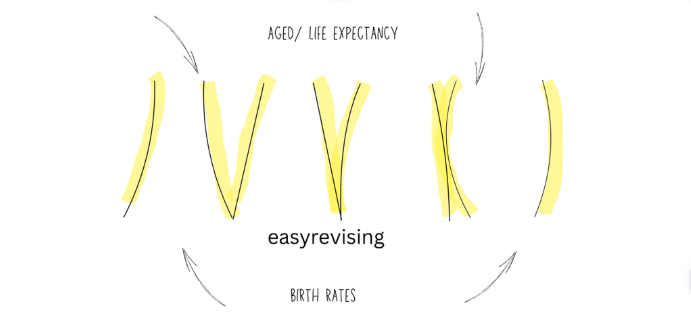
Key parts:
- Base: birth rate
- Top: life expectancy
- Slope: how fast people die off
- A triangular pyramid (broad base) shows a youthful and growing population
- An inverted pyramid (broad tip) shows an ageing population
Uneven Gender Ratios
If you spot gaps in age or gender categories, you’re looking at uneven gender ratios. These are not random. They’re often shaped by policy or migration. I explained this in more detail in my video, but to briefly summarise: in some countries, a significant number of working-age men may migrate abroad to work in construction sectors in places like Dubai or Singapore. Similarly, women may leave to take up domestic work in other Southeast Asian countries. These trends lead to temporary imbalances in the population structure, which can be clearly seen in the pyramid.
Meanwhile anti-natal policies like China’s former one-child rule skewed gender balances.
Other anomalies may be caused by factors like war which reduces the number of males in certain age groups. while exact figures vary, it’s estimated that over 100,000 Ukranian soldiers have died in the ongoing conflict with Russia—an event that could leave a noticeable gap in the population structure.
Bulge? A good thing
Then there’s the demographic dividend — the sweet spot. This happens when a country has a large, youthful population and a falling fertility rate. If timed right, this can lead to a surge in the working-age population, boosting economic growth — but only if there are enough jobs and infrastructure to support it.
Read here for more on Demographic Dividend
Read here for more on China’s Anti-Natal One-Child Policy
See Population Pyramids in this 8-min exam Walk-Through
Full Population Revision Pack available